
Open cell and closed cell
Spray Foam Insulation in Galveston, TX
Insulation and air sealing in one step, matched to coastal heat, wind and moisture.
- Free estimates after we see the space
- Written quotes listing foam type, thickness and R-value per area
- Moisture, flood damage and air leaks checked before anything is covered
Where Spray Foam Works Best on the Coast
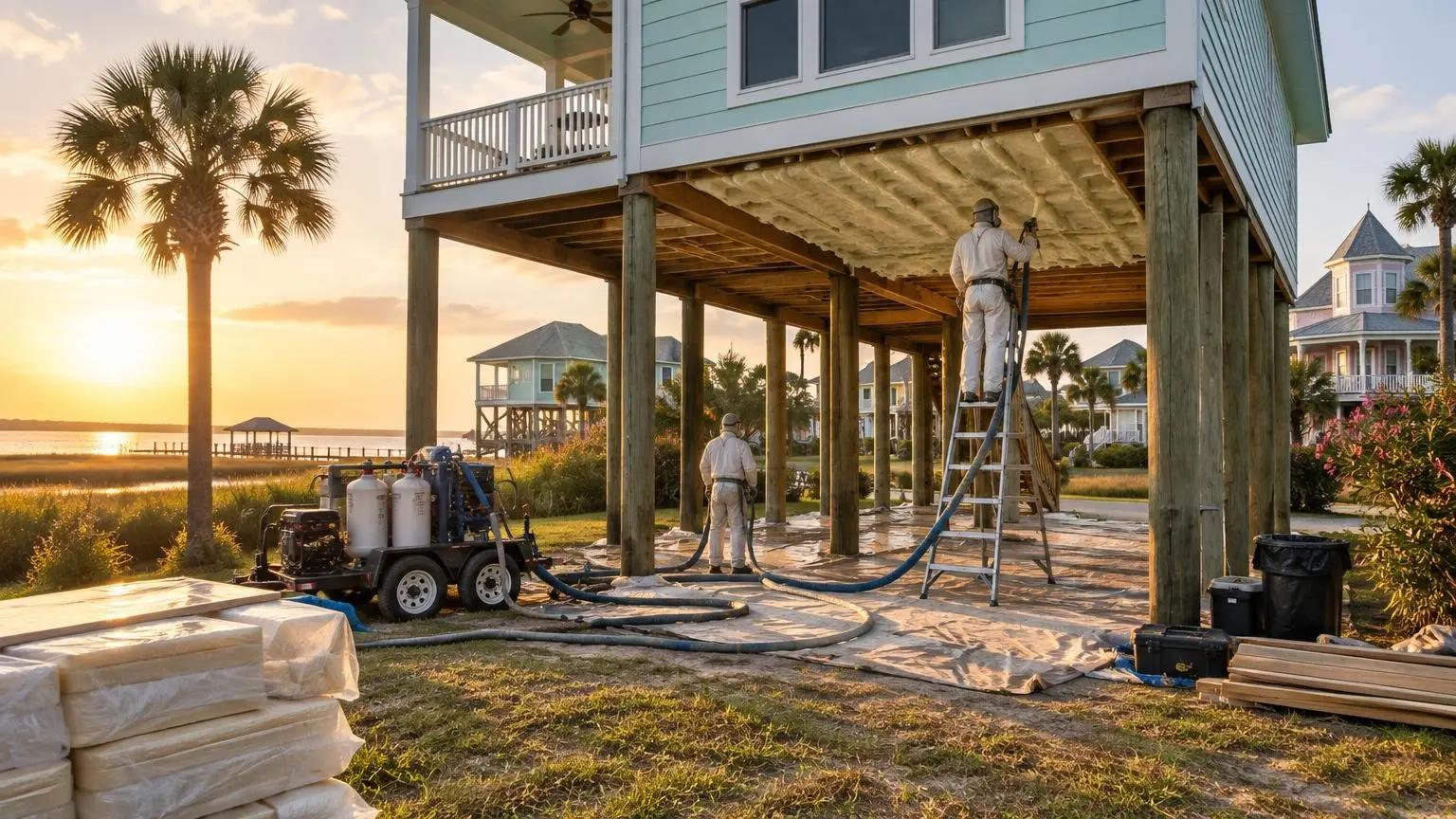
Spray foam insulation is sprayed as a liquid that expands and hardens in place. It fills gaps around framing, wiring and plumbing that batts and loose fill miss, so it insulates and air seals at the same time. In Galveston County, where OpenEI places the county in Climate Zone 2A and cooling runs most of the year, foam is especially useful on roof decks over attics with ducts, under raised floors, in walls of new homes and additions, and inside metal buildings.
Open-cell foam
Open-cell foam is light and spongy, rated about R-3.5 to R-3.7 per inch by HomeGuide. It expands a lot, fills cavities completely and costs less. It lets water vapor pass, so it is a good fit in interior walls, many exterior walls and some roof decks, but not where it could get wet from flooding or wind-driven rain.
Closed-cell foam
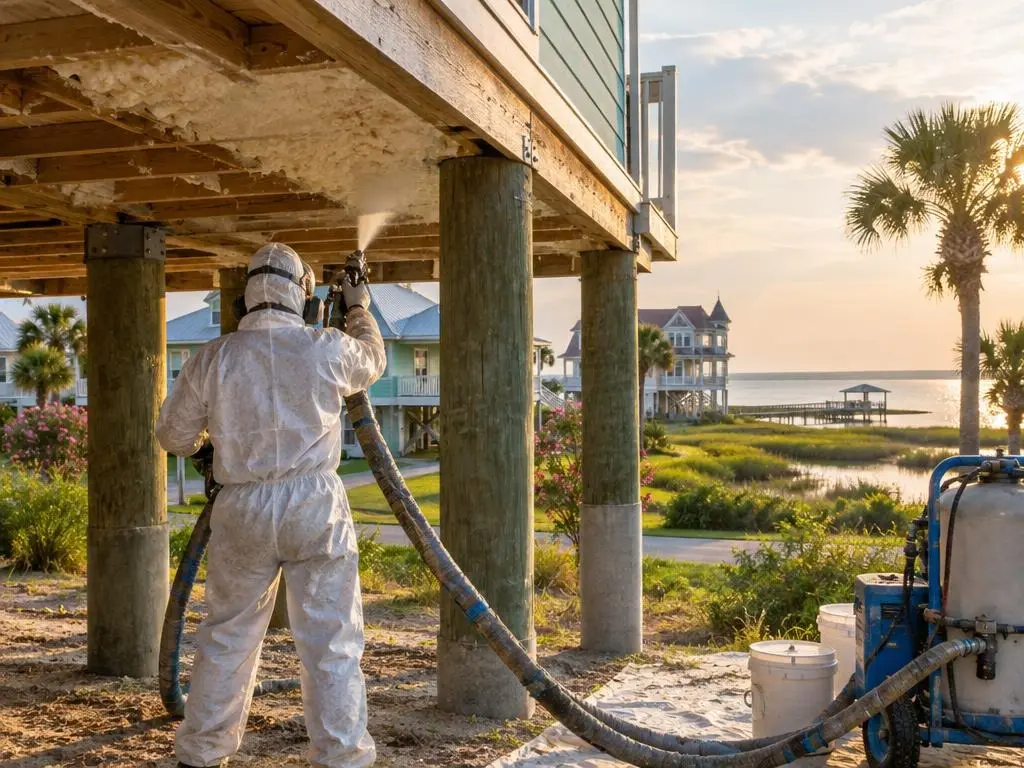
Closed-cell foam is dense and rigid, rated about R-5 to R-7 per inch. A couple of inches slows vapor, sheds water and stiffens the surface. On the coast it is the usual choice under raised floors, on surfaces below base flood elevation, inside steel buildings and on roof decks where a vapor retarder makes sense. It costs more per square foot, but it holds up where other insulation fails.
Signs foam is the right choice
A hot upstairs with ducts in the attic, a cold or clammy floor in a raised home, a metal shop that drips, a bonus room that never cools, or new framing that you want sealed tight are all good reasons to look at spray foam. If the only issue is a thin attic floor, sealing and blowing insulation may be cheaper, and we will tell you so.
Code and safety
The Insulation Institute's Texas summary lists R-38 ceilings and R-13 wood-frame walls in Zone 2. Foam in living spaces is covered by a thermal barrier such as drywall; attics and crawl areas may need an ignition barrier depending on use. HomeGuide advises staying out of the house for 24 hours or more after spraying, and we ventilate the area during and after the work.
Where We Spray
Common foam applications in Galveston County homes and buildings.
Roof decks
Foam under the roof sheathing to bring the attic and ducts inside the envelope.
Raised floors
Closed-cell foam on the underside of floors exposed to wind and salt air.
New walls and additions
Open or closed cell in open stud bays before drywall.
Bonus rooms and kneewalls
Sealing the edges and walls of rooms next to hot attic space.
Metal buildings
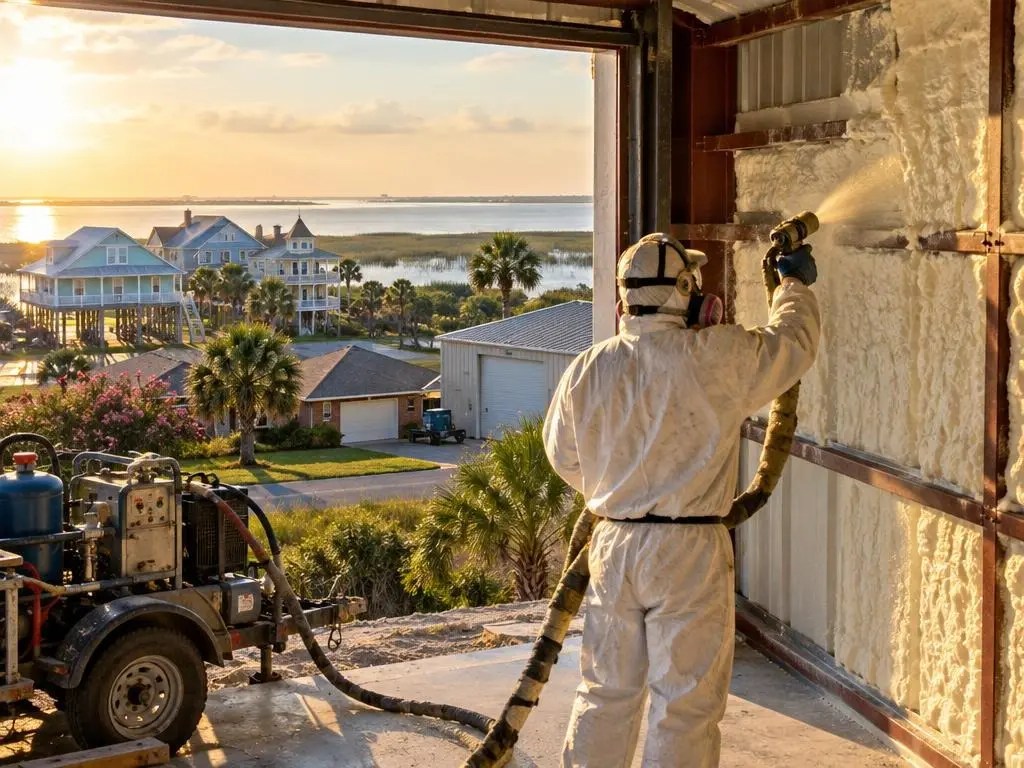
Closed-cell foam to stop condensation and heat gain.
Rim and band areas
Sealing where the floor framing meets the walls.
Published Spray Foam Insulation Costs
| Job | Range and source |
|---|---|
| Spray foam, installed | $1.50 to $5.00 per sq ft (HomeGuide) |
| Open-cell / closed-cell | $1.50 to $3.50 / $3.00 to $5.00 per sq ft (HomeGuide) |
| Around 1,000 sq ft | $1,500 to $5,000 (HomeGuide); $3,150 to $7,500 in existing homes (Fixr) |
| Existing walls / new construction | $3.15 to $7.50 / $2.75 to $6.50 per sq ft (Fixr) |
| All exterior walls | $4,000 to $10,000 (HomeGuide) |
| Entire house | $8,000 to $20,000 (HomeGuide); $10,000 to $30,000 (Fixr) |
| Usual minimum charge | $1,000 to $2,000+ (HomeGuide) |
National ranges from HomeGuide (2026) and Fixr (2025). Foam type, thickness, access, height of a raised home and prep all affect the total, and small jobs often hit a minimum. Your written estimate is the price.
How a Spray Foam Job Works
1. Inspect
We check the surfaces, look for leaks, rot, corrosion and moisture, and measure.
2. Quote
Foam type, thickness, R-value and price by area, in writing.
3. Prep
We mask, cover and ventilate, and confirm surfaces are dry.
4. Spray
Foam goes on in passes to the specified depth, then is trimmed and checked.
5. Ventilate and review
The area is ventilated until ready and we walk it with you.

Why Choose Us for Spray Foam Insulation
Foam picked per surface
Closed-cell where water can reach it, open-cell where it cannot.
Thickness checked
We measure depth as we spray.
Problems flagged first
No foam over leaks, rot or wet framing.
Spray Foam Insulation Questions
Is closed-cell foam worth the extra cost on the coast?
Where water or wind can reach the insulation, usually yes. It does not absorb water and holds up better under raised floors and below flood elevation.
Will spray foam stop humidity in my house?
Foam reduces humid outdoor air leaking in, which helps. Your air conditioner still handles indoor humidity, and a very tight house may need planned ventilation.
Can spray foam go into existing walls?
Standard spray foam needs open cavities. For closed walls we usually recommend dense-pack blown insulation, or foam when walls are opened during remodeling.
How long does spray foam last?
Properly installed foam that stays dry does not sag or settle. It should last as long as the structure.
Does foam void a roof warranty?
Some shingle manufacturers have rules about unvented roof decks. Check your roof warranty, and we can discuss options if that is a concern.
Spray Foam Insulation Service Areas
- Spray Foam Insulation in Galveston, TX
- Spray Foam Insulation in Jamaica Beach, TX
- Spray Foam Insulation in Bolivar Peninsula, TX
- Spray Foam Insulation in Tiki Island, TX
- Spray Foam Insulation in Hitchcock, TX
- Spray Foam Insulation in La Marque, TX
- Spray Foam Insulation in Texas City, TX
- Spray Foam Insulation in Santa Fe, TX
- Spray Foam Insulation in Dickinson, TX
- Spray Foam Insulation in League City, TX
- Spray Foam Insulation in Kemah, TX
- Spray Foam Insulation in Clear Lake Shores, TX
- Spray Foam Insulation in Bacliff, TX
- Spray Foam Insulation in San Leon, TX
- Spray Foam Insulation in Friendswood, TX
Get a Spray Foam Insulation Estimate
Tell us which surfaces you want foamed and we will measure and quote each one.